Activity Workshop · Printables
Alphabet bingo for kids: learning letters through play
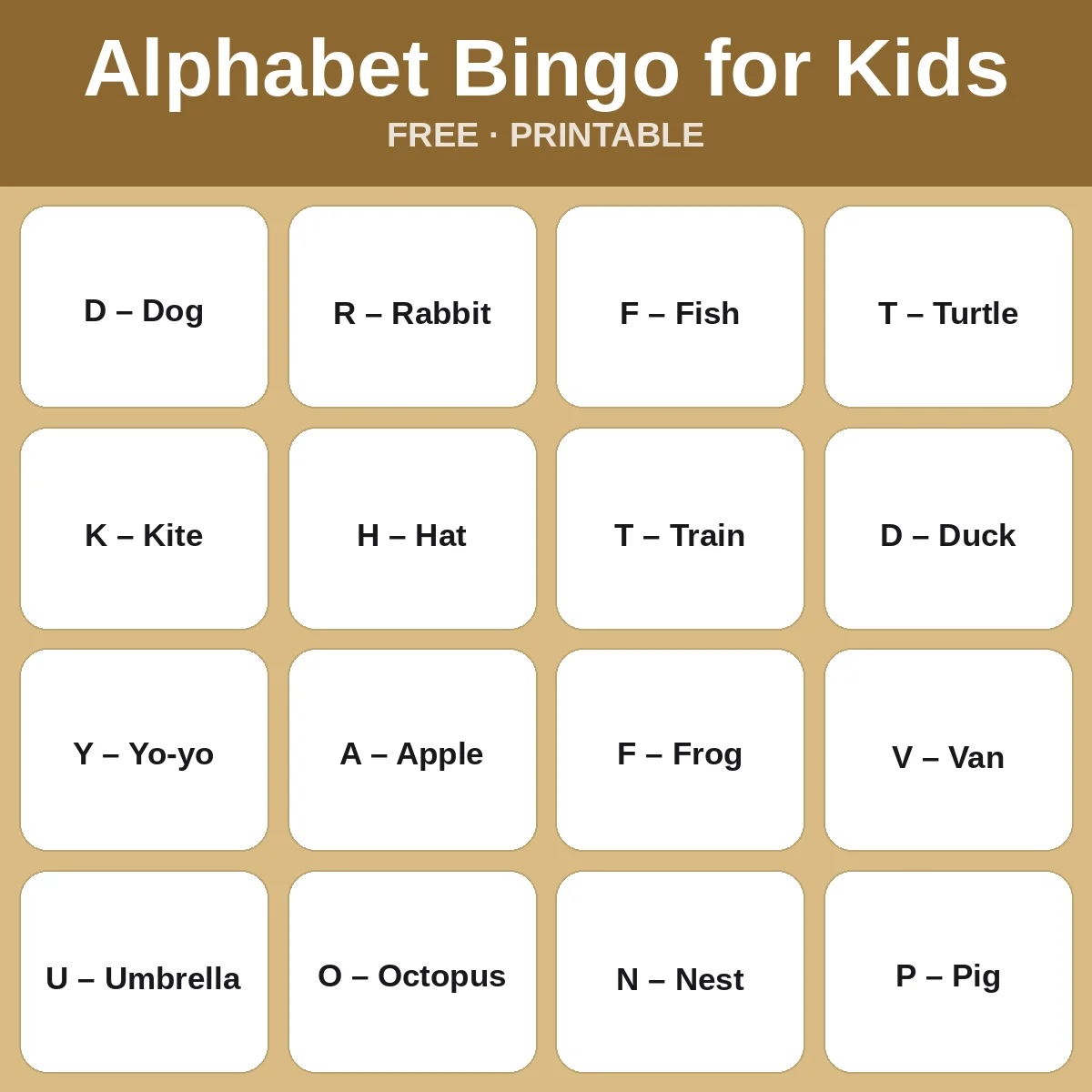
Alphabet bingo is a simple, hands-on way to practice letters without the drill-and-repeat feel of flashcards. Every square on the board pairs a letter with a word a young child already recognizes, like "B for Ball" or "S for Sun" — so the letter has something concrete to attach to instead of floating alone in a recited alphabet song.\n\nThe set covers all 26 letters, with a few popular ones like A, B, S, and T appearing twice on different cards for variety. It works just as well as a quiet before-dinner activity at the kitchen table as it does as a group game in a preschool classroom or after-school program, where several children can each play their own board at the same time.
Download free
Pick an age, download the A4 PDF with answers, and print. No sign-up.
Pick an age — download PDF

About this sheet
Preschool and kindergarten teachers often reach for something visual to break up a letter drill, and alphabet bingo does exactly that. Each card only needs a glance to connect — B is for Ball, S is for Sun — so even a child who is still shaky on letter names can play alongside classmates who read fluently. Call the pairs slowly the first few rounds and most children pick up the calling pattern within a game or two.
The word choices lean on things a 4-to-7-year-old already knows by sight: animals, food, everyday objects. That familiarity is the point — a child recognizing the picture before the letter is a normal, useful step toward recognizing the letter on its own. Popular letters like A, B, S, and T get a second card each, so a full classroom set stays busy and no two boards feel identical.
Print one board per player (or laminate a class set to reuse all year), grab dried beans, buttons, or bingo chips as markers, and call letters from a shuffled deck of the same 36 cards. A caller reads the letter and word together the first round or two, then switches to the letter alone as confidence builds — a simple way to make the game harder without changing the rules.
This set slots into circle time, a rainy-day table activity, or a quiet stretch at the kitchen counter before dinner. It also pairs naturally with a number bingo set for the same age group, giving families and classrooms a second round-robin activity that reuses the same markers and the same five minutes of setup.
What you get
- 36 printable letter-bingo cards covering all 26 letters, with extra cards for popular letters
- A matching set of calling cards to cut out and shuffle for the caller
- A clean, print-friendly layout that stays legible in black and white or laminated color
How to use it
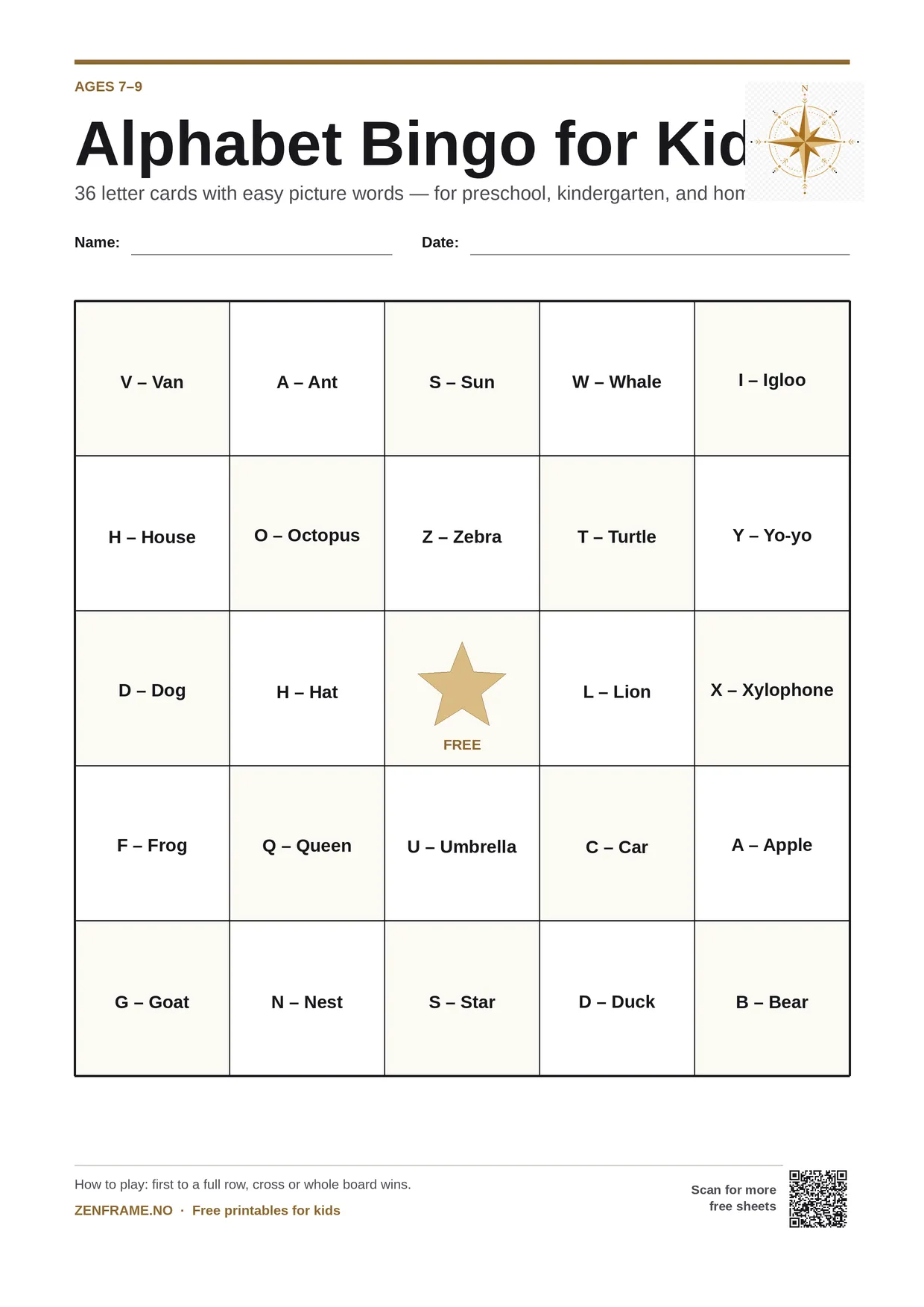
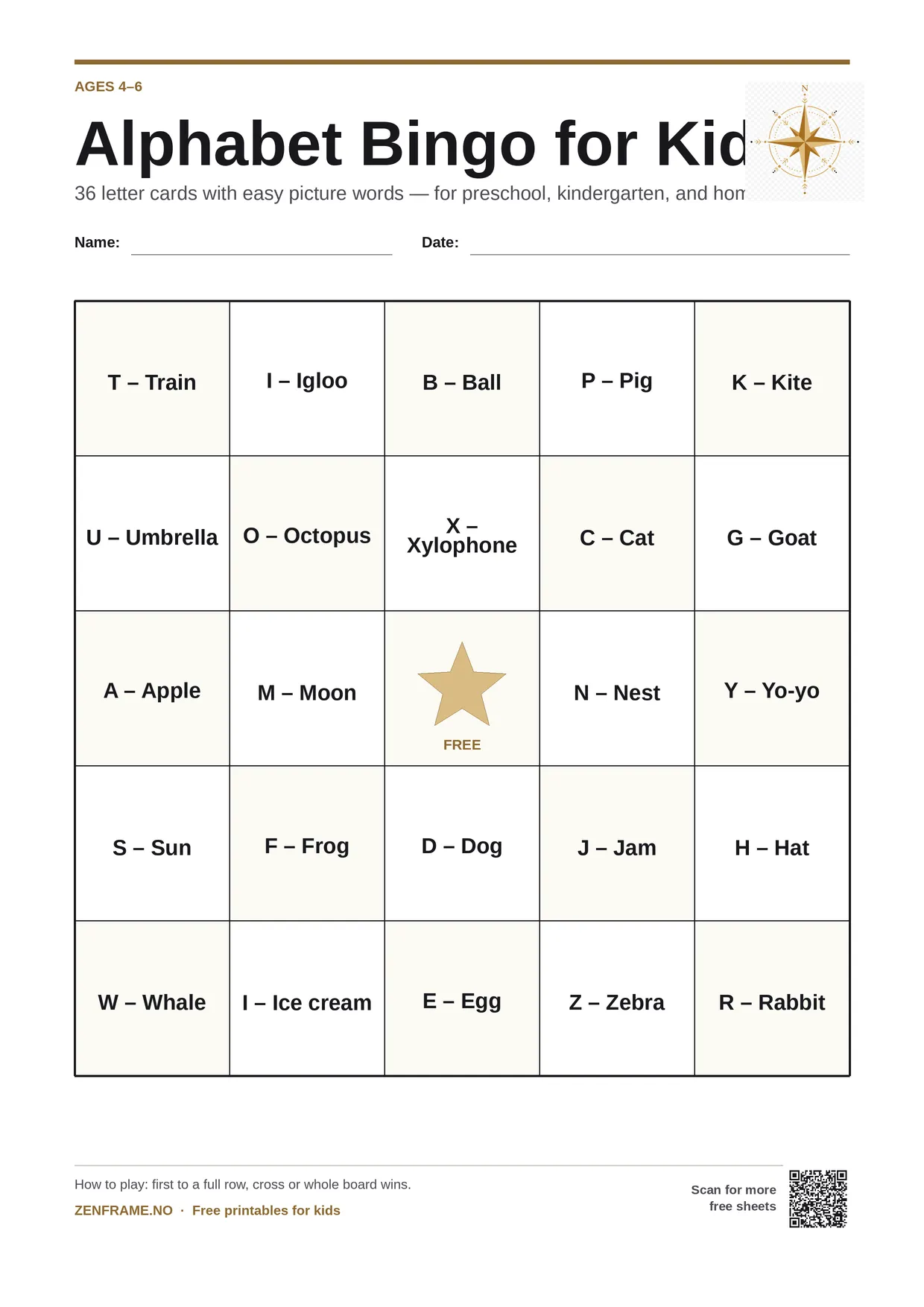
- Print the boards. Print one bingo board per player, or laminate a class set of boards to wipe clean and reuse across the school year.
- Shuffle the calling cards. Cut out the matching set of 36 letter-and-word cards and shuffle them into a deck the caller draws from.
- Call and mark. Draw one card at a time, say the letter and word aloud (letter alone once players are ready), and have each child mark the matching square with a bean, button, or chip.
- Play to a full row or full board. First player to complete a row, column, or the whole board calls bingo — then reset markers and start a new round.
More versions of this sheet
Frequently asked questions
- What age is alphabet bingo good for?
- It's built for ages 4 to 7 — preschool through first grade. Younger players can match the letter shape to the picture even before they know the letter sound, while older players can play by letter name alone, so one printable set covers a range of readiness levels in the same classroom or family.
- How many players can use one set?
- The 36 cards support a full classroom when you print one board per child and call letters from a shared deck. At home, two to six players works well around a kitchen table; just make sure each printed board has a different arrangement so no two players win on the exact same call.
- Do I need special markers to play?
- No. Dried beans, buttons, coins, or torn paper squares all work fine as markers. If you plan to reuse the boards across the school year, laminating them and using dry-erase markers or bingo chips keeps the set durable and easy to wipe clean between rounds.
- Can this replace flashcard letter drills?
- It works best alongside flashcards rather than instead of them. Bingo adds a playful, low-pressure format where children see the letter and word together in a game context, which reinforces recognition built through more direct drilling without feeling repetitive.
- Is there a matching number bingo set?
- Yes — Zenframe's number bingo printable uses the same board size, marker style, and calling format, just with numbers instead of letters. Many teachers and parents rotate between the two sets so the group has a fresh game without learning new rules each time.