Getting to Know You Bingo for Kids
Activity Workshop · Printables
Getting to Know You Bingo for Kids
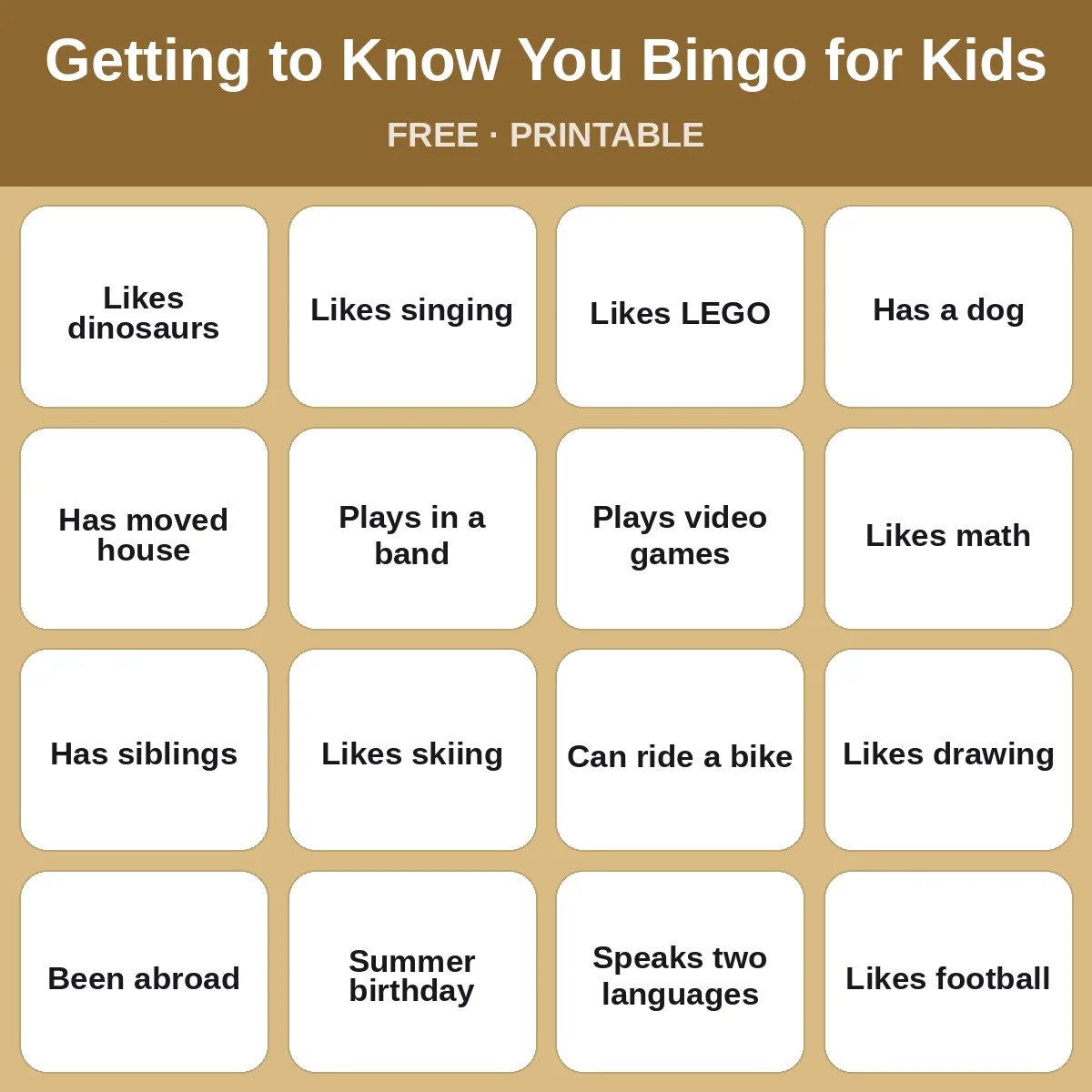
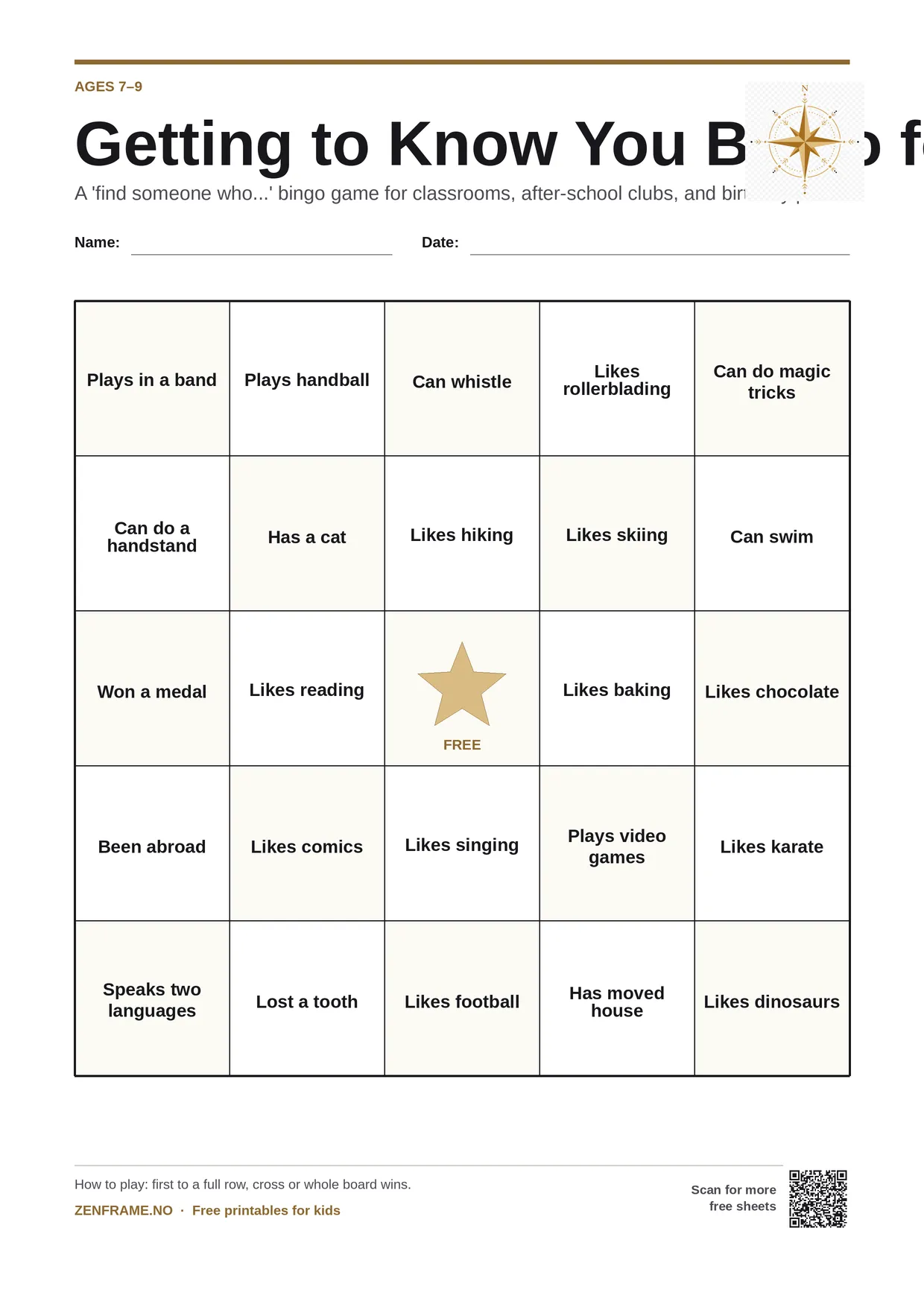
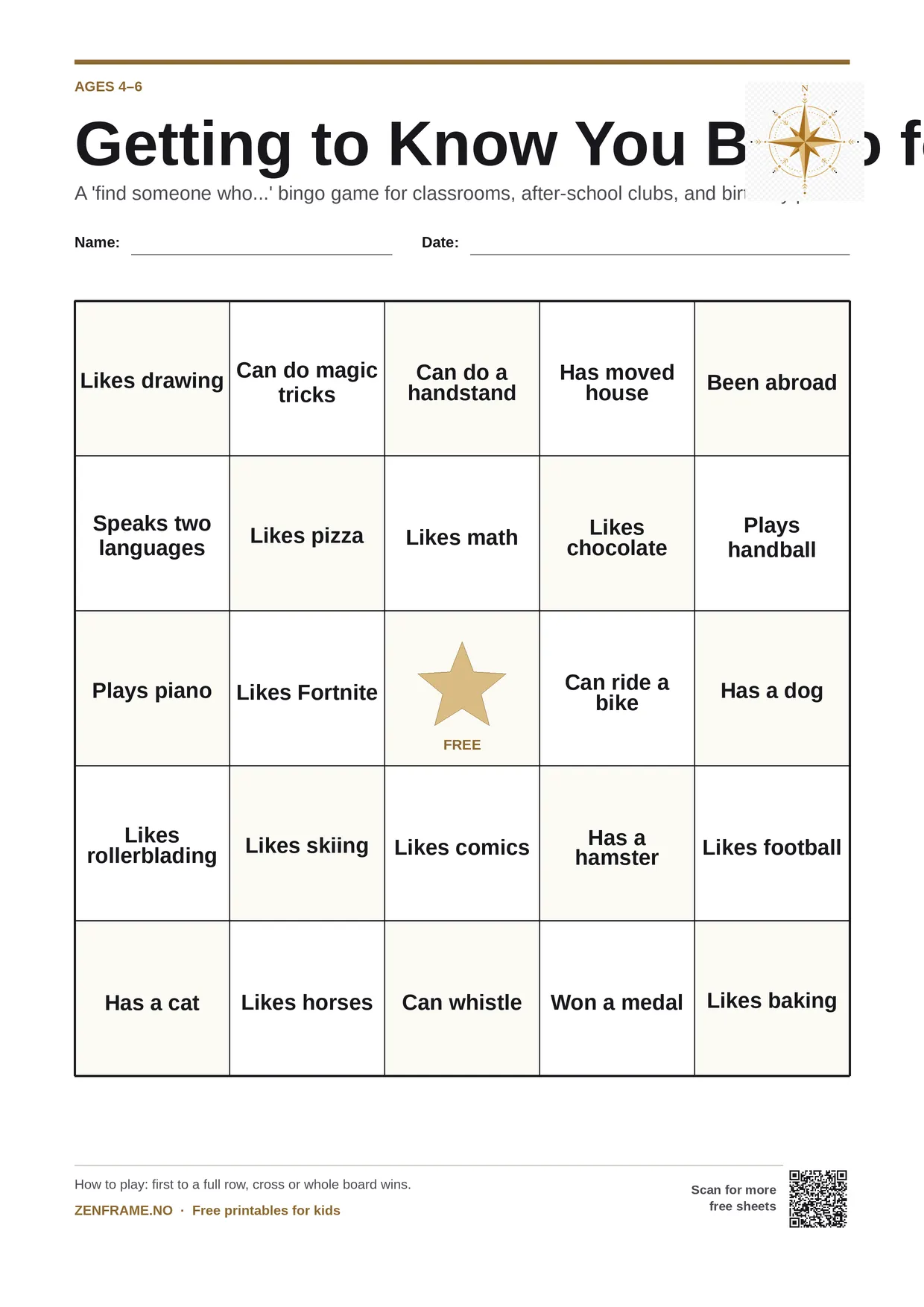
Getting to Know You Bingo is a simple "find someone who..." game where kids move around the room asking each other questions, checking off a box every time they meet someone who matches. The board comes ready-made with 36 of the most common icebreaker prompts, so it's ready to print for a classroom, an after-school club, or the next birthday party. The game needs nothing beyond a printed board and a pen for each child. It works especially well in the first weeks of a new class or group, when kids don't know each other yet, and it doubles as a calm opening activity at a birthday party where not all the guests are already friends.

About this sheet
Each child gets one printed board and walks around the room asking classmates questions drawn straight from the boxes — "do you have a dog?", "can you swim?", "do you play piano?" When they find a match, that classmate signs or initials the box. Whoever completes a full row, column, or the entire board first calls out "Bingo!"
In a full classroom or after-school group, set a time limit of ten to fifteen minutes so the game doesn't drag once most boxes are filled. Circulating adults can nudge quieter corners of the room together and remind kids that repeating the same classmate on different boxes doesn't count — each square needs a different match.
For shy children, start by pairing them with one confident classmate for the first few minutes instead of sending them into the whole room at once. Some kids do better holding up their board and pointing at a box rather than asking a question out loud, and that still counts as a match. A teacher or activity leader can also call out one or two boxes together as a group warm-up before kids split off on their own.
At a birthday party, the board works well as the very first activity, while guests are still arriving and don't yet know each other. It gives children something concrete to do with their hands instead of standing around, and it naturally mixes kids who came from different friend groups or classes.
What you get
- One printable bingo board with 36 icebreaker prompts
- Print-ready PDF — no sign-up or login required
- Works for ages 5–12 in classrooms, after-school clubs, or birthday parties
- Reusable for every new class, group, or party guest list
How to use it
- Print one board per child. Print the bingo board single-sided, one copy per child, plus a pen or pencil for each player.
- Explain the one rule. Kids walk around asking classmates the question on each box until they find someone who matches, then get that person to sign or initial the square.
- Race for a row or the full board. Decide in advance whether one line wins or the whole board is needed, then let the first child to finish call 'Bingo!'
- Ease shy kids in first. Pair quieter children with one partner for the opening minutes, or let them point at boxes instead of asking out loud, before opening the game up to the whole room.
Download free
Pick an age, download the A4 PDF with answers, and print. No sign-up.
More versions of this sheet
Frequently asked questions
- How do you play Getting to Know You Bingo?
- Give each child a printed board and a pen. They walk around asking classmates questions like 'do you have a dog?' or 'can you swim?' until they find someone who matches a box, then get that person to sign or initial it. The first to complete a row, column, or the full board wins.
- What age group is this bingo game for?
- The board works well from around age 5 through 12. Younger children who can't read yet can still join in if an adult reads the boxes aloud or pairs them with an older buddy who explains each prompt.
- How many kids can play at once?
- There's no upper limit since everyone plays independently while moving around the same room. It works with a full class of 25 to 30 children just as easily as with six or seven kids at a birthday party.
- How do I help shy kids join in?
- Pair a shy child with one confident partner for the first few minutes so they have a safe way in, or let them approach classmates one at a time instead of calling out questions across the room. Some children also prefer pointing at a box on their board instead of asking out loud, which still counts as a match.
- Do I need anything besides the printout?
- No extra materials are needed beyond one printed board and a pen or pencil per child. A small prize for the winner is a nice touch, but it isn't required to play.
- Can I use this for a birthday party instead of a classroom?
- Yes, it works well as a calm opening activity when guests don't all know each other yet. Playing it in the first ten minutes gives kids something to do while everyone arrives and breaks the ice before games or cake.