Activity Workshop · Printables
Kitchen Bingo Printable for Kids – Free Download
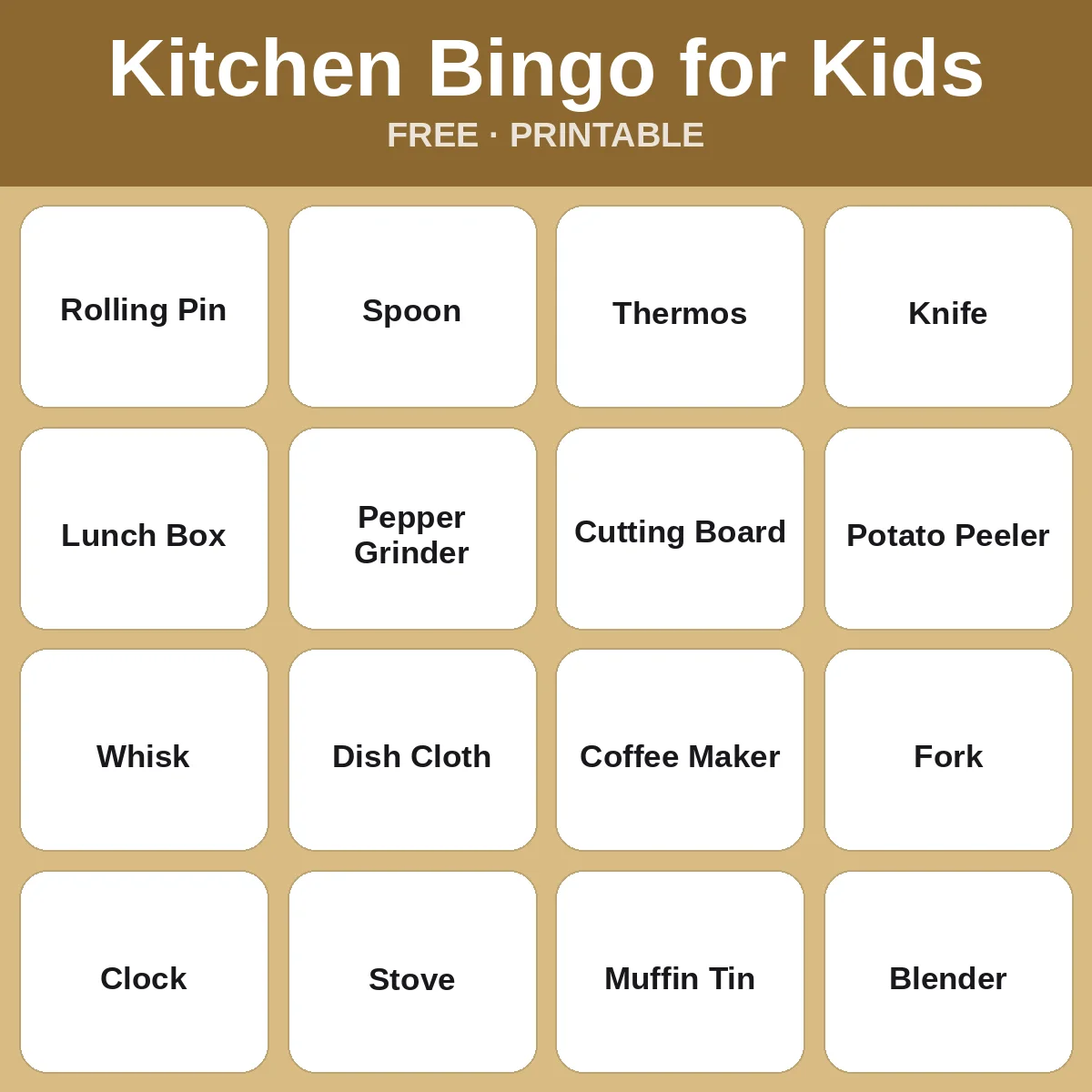
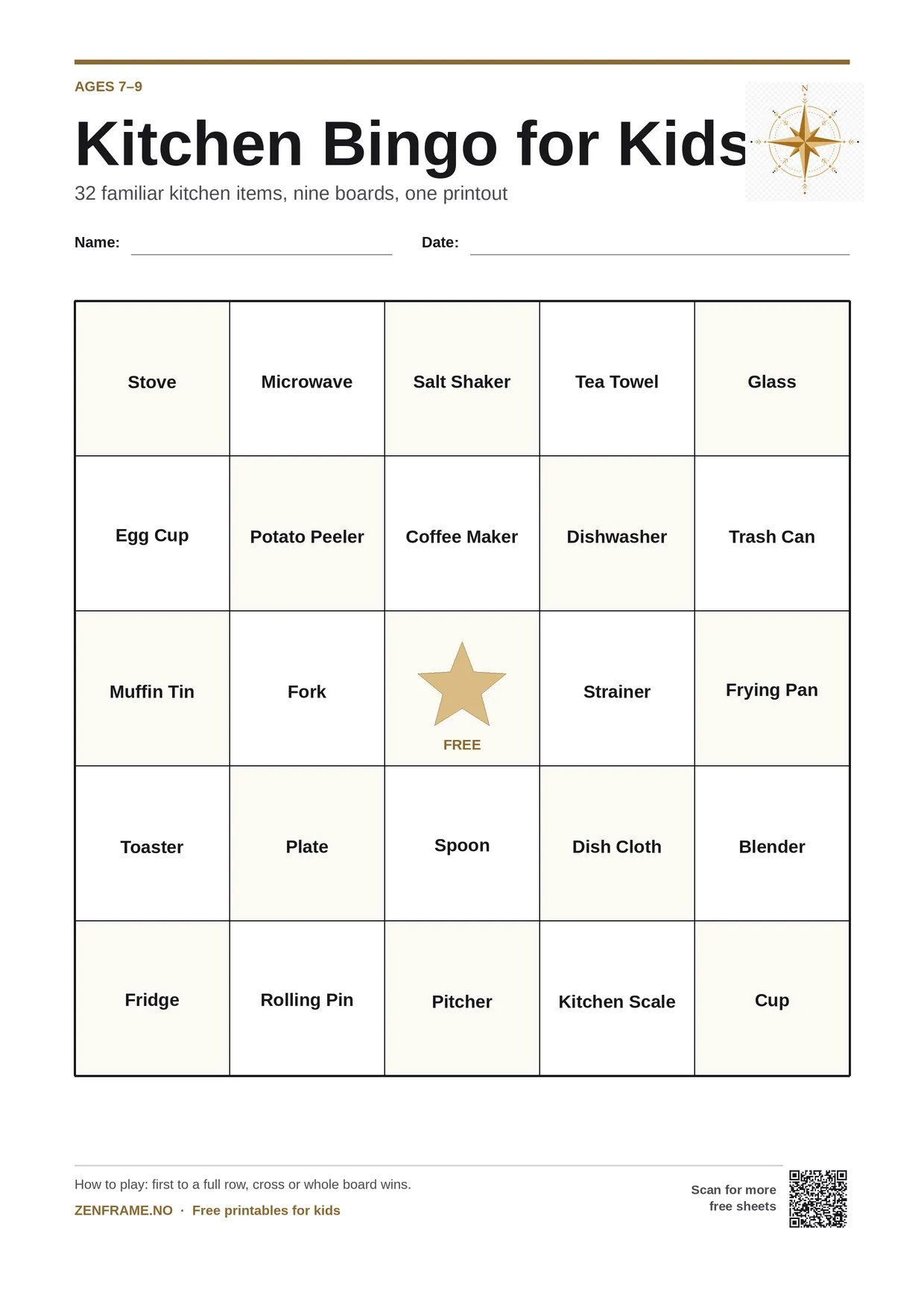
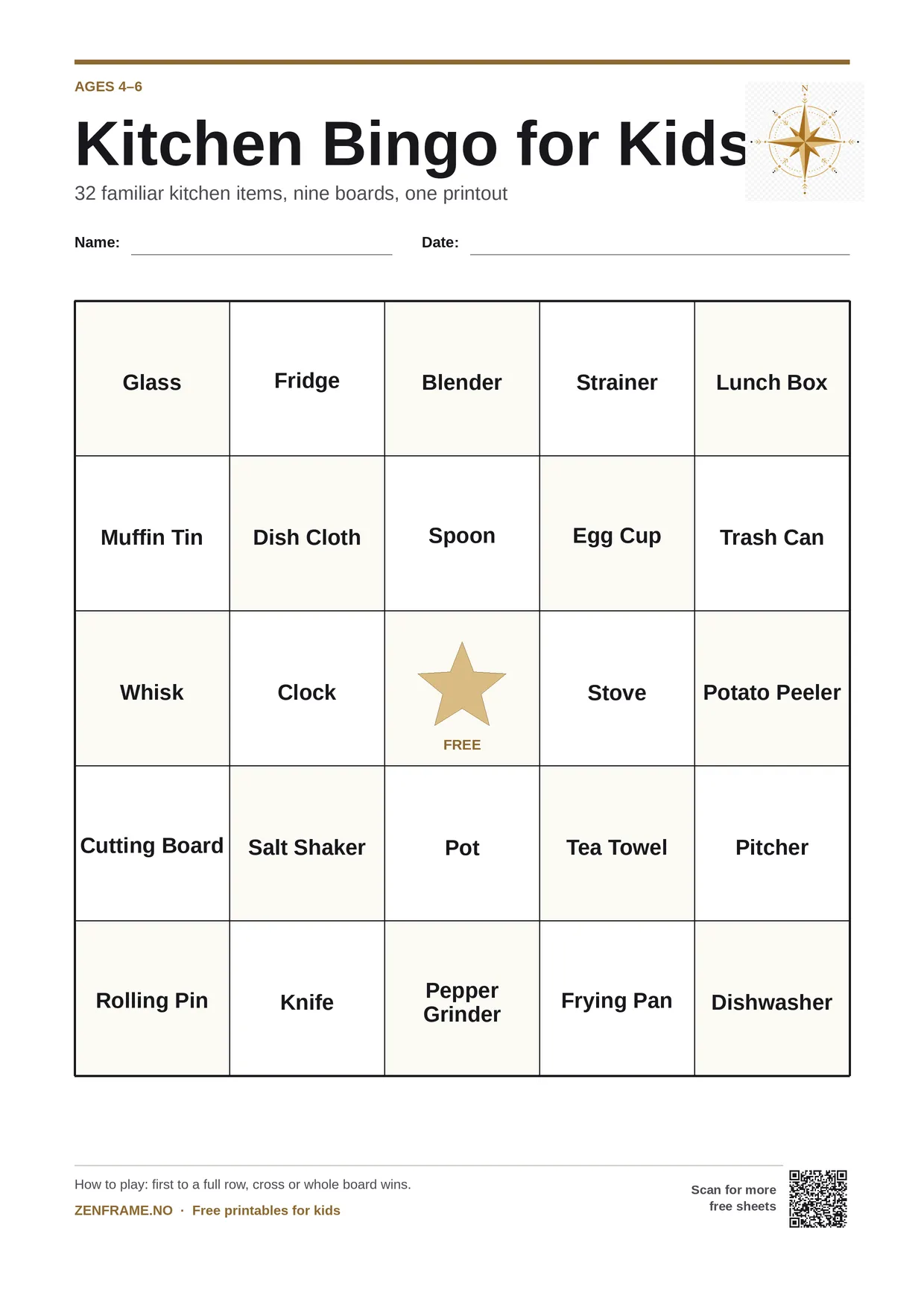
Kitchen bingo is a simple recognition game for the youngest kids: nine different bingo boards filled with 32 things you'd actually find in a kitchen, from a fork and a pot to a whisk and a fridge. There's nothing to prepare beyond printing, and no rules to learn beyond ordinary bingo — just objects children already recognize from the breakfast table or the preschool kitchen.\n\nIt's built to fill a quiet stretch at daycare, after-school care, or around the kitchen table at home, without an adult having to invent anything new. Print it, hand out one board per child, and let someone call out items from the list while the group marks their boards.
Download free
Pick an age, download the A4 PDF with answers, and print. No sign-up.
Pick an age — download PDF

About this sheet
A kitchen bingo printable works because it borrows a room every child already knows by heart. There's no theme to explain and no vocabulary to pre-teach — a fork, a fridge, a whisk are things a three- or four-year-old has handled or watched an adult use that same morning. That familiarity is what makes the game move fast: kids call out answers with confidence instead of guessing, which keeps a preschool group or a home afternoon from stalling out after five minutes.
This set is built for the moments that actually need filling — a rainy indoor recess, the last twenty minutes before pickup, a quiet stretch at the kitchen table while dinner is in the oven. Search for a kitchen bingo printable and most results assume a printer, a laminator, and a craft cabinet nearby; this one assumes only a home printer and a stack of paper. Nine boards means a small class or a handful of siblings can all play the same round without duplicate winners.
For preschool and kindergarten teachers, it doubles as a low-pressure vocabulary check: calling items instead of showing pictures nudges kids to listen for the word before they scan the board, which is exactly the skill circle time is trying to build. For parents, it's a five-minute setup that turns a kitchen full of real objects into a matching game the child can play again the next time without any adult re-explaining the rules.
Play it the ordinary bingo way. One adult (or an older sibling) reads items off the list in any order; each child marks the matching square on their own board with a coin, a bean, or a crayon dot. First to complete a row, column, or the whole card calls it out — and because every board mixes the same 32 items differently, no two winners land on the same combination twice in a row.
What you get
- Nine unique bingo boards, ready to print on standard A4 or Letter paper
- 32 everyday kitchen items kids already recognize from breakfast or snack time
- A calling list so an adult or older sibling can read out items in random order
- No lamination or cutting required — print and play the same afternoon
- Works for groups up to nine players without any two boards matching
How to use it
- Print the boards. Print all nine bingo boards on standard A4 or Letter paper, plus the item list that comes with the set. No special paper or lamination needed — regular printer paper holds up fine for one or several rounds.
- Hand out one board per player. Give each child a different board and something to mark squares with — coins, dried beans, buttons, or a crayon all work. Nine unique boards mean a group of up to nine can play the same round side by side.
- Call items from the list. One adult or an older sibling reads items from the list in any order, one at a time. Players scan their own board and mark the matching square each time they hear an item they have.
- Play to a row or a full card. Decide in advance whether a win is one row, one column, or the whole board, then play until someone calls it out. Reshuffle the calling order and go again — the mixed layouts mean each round still feels different.
More versions of this sheet
Frequently asked questions
- What age is this kitchen bingo printable meant for?
- It's designed for preschool and early kindergarten ages, roughly three to six, since every item is something a young child has already seen or handled in a real kitchen. The vocabulary stays simple on purpose so the game rewards recognition rather than reading ability, which makes it playable even for kids who aren't reading fluently yet.
- How many players can use one set of boards?
- Each set includes nine different boards, so up to nine children can play the same round at once without two people holding an identical card. For a bigger class, print extra copies of a few boards — duplicate boards only cause a problem if two winners need separating, which a coin toss solves in seconds.
- Do I need anything besides a printer to play?
- No. Print the boards on regular A4 or Letter paper, then use coins, dried beans, buttons, or a crayon to mark called squares — there's no laminating, cutting, or extra prep required. One adult reading from the included item list is all it takes to run a full round.
- Can this double as a vocabulary or language activity?
- Yes. Because someone calls out the word before showing any picture, kids have to match a spoken item name to an object on their board, which is a genuinely useful listening exercise for early vocabulary building. Teachers often use it exactly this way during circle time or a quiet transition between activities.
- Is this the same as the kitchen bingo used in daycare or SFO settings?
- It's built for that setting specifically — quiet, low-mess, no equipment beyond paper and something to mark squares with, and short enough to finish in one sitting. It works equally well at a kitchen table at home, which is why it's shared as a free printable rather than a classroom-only resource.