Activity Workshop · Printables
Movement Bingo for Kids – Free Printable
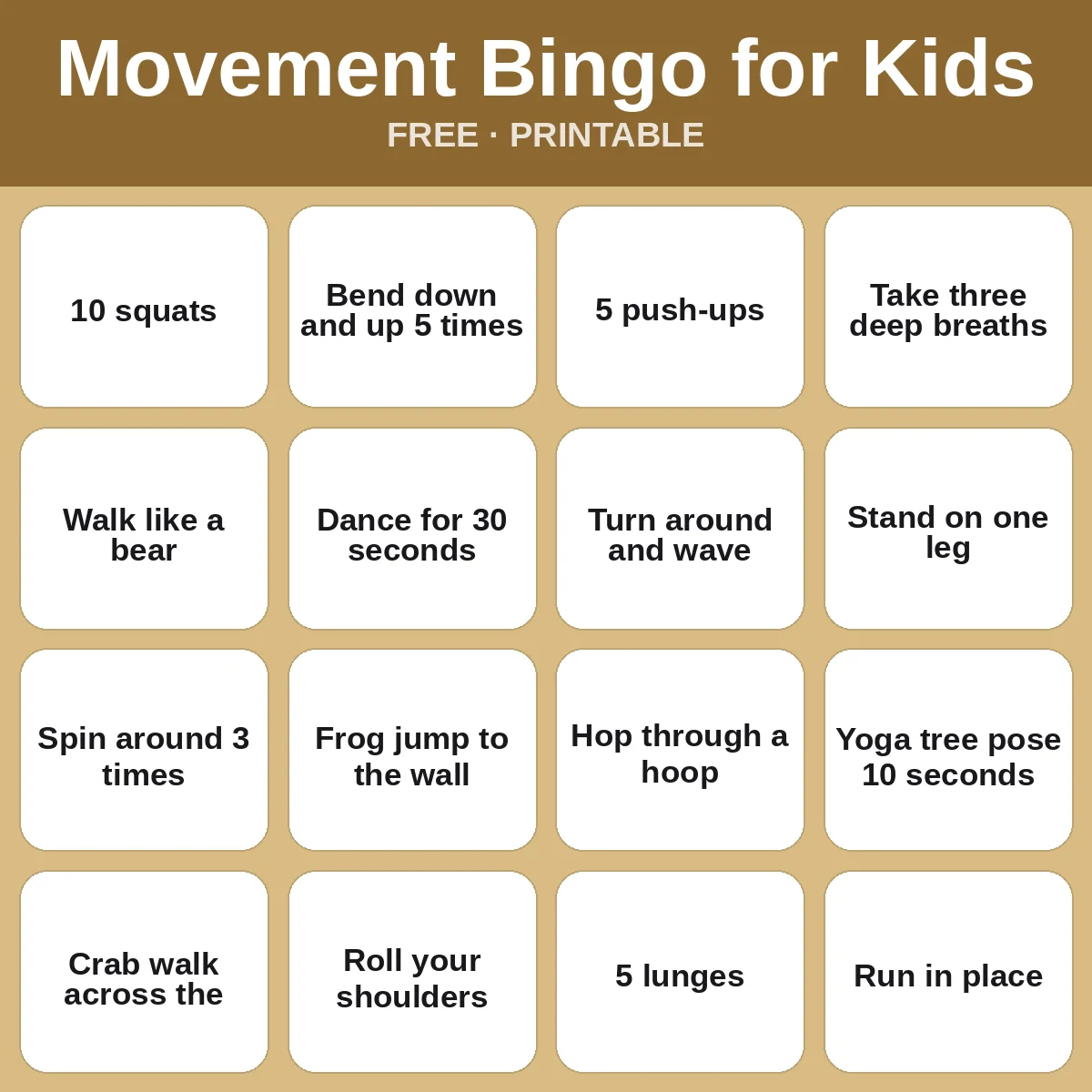
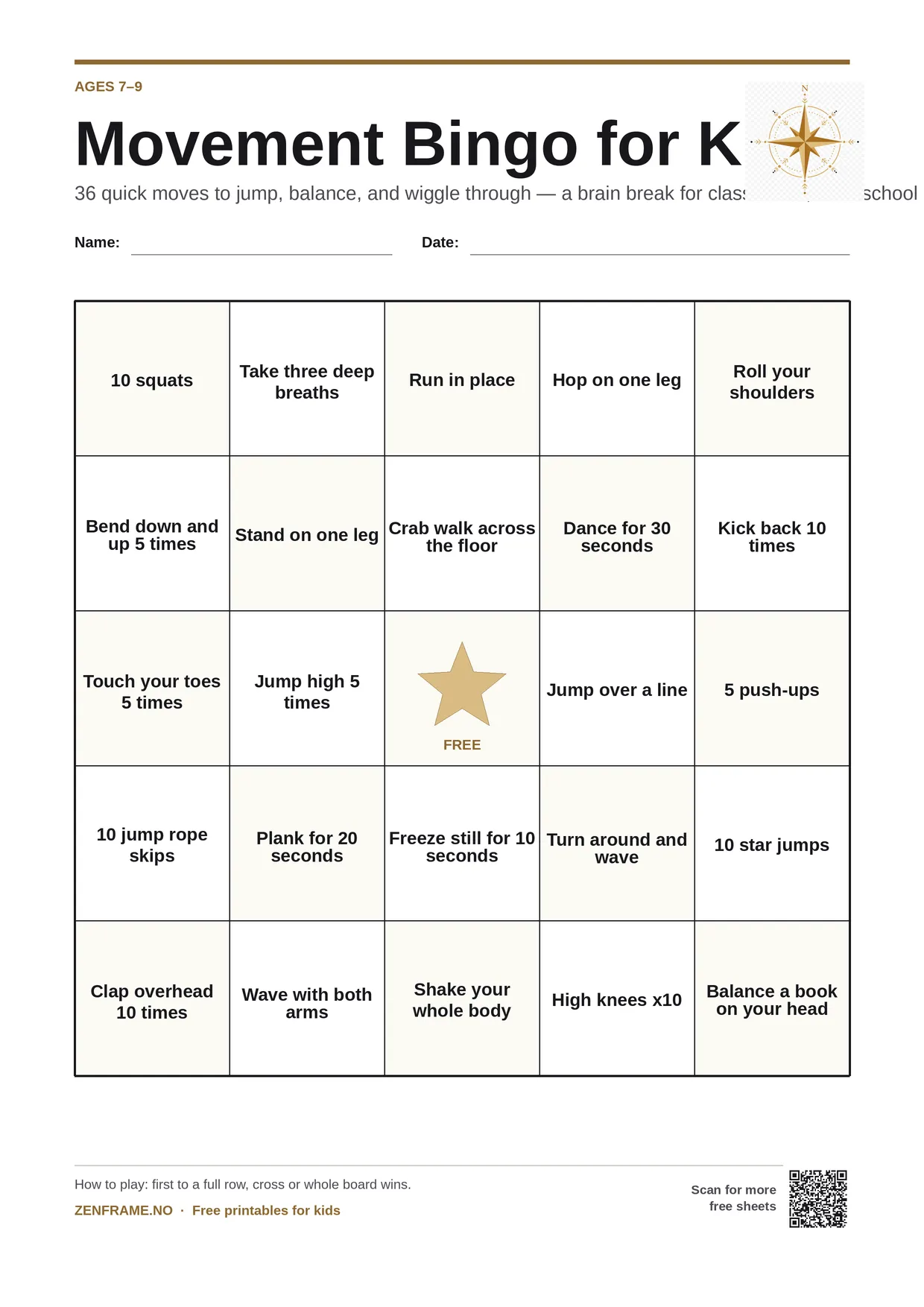
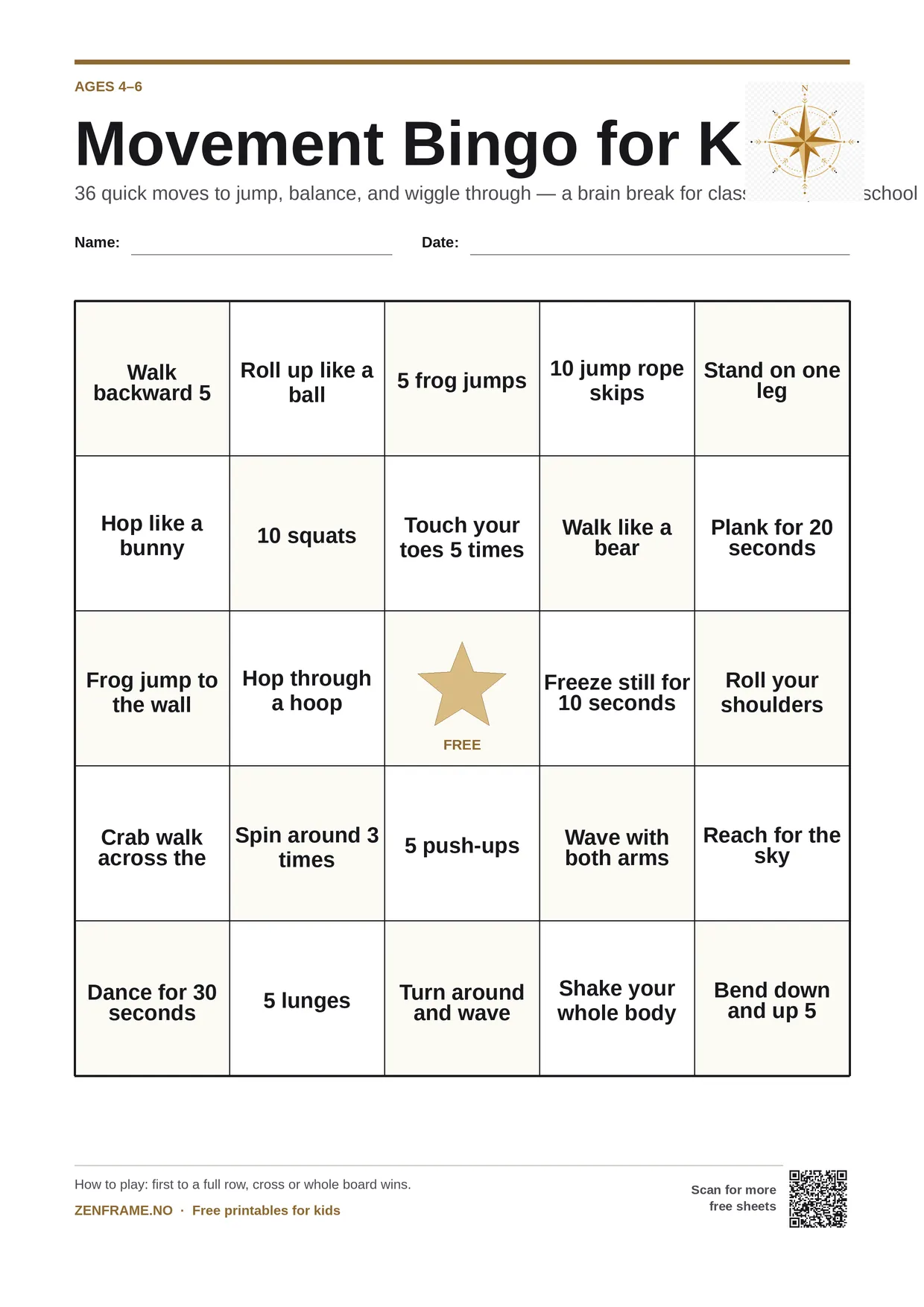
Movement bingo is a ready-made activity for the short gaps every day needs between sitting still and getting focused again — in the classroom, at after-school care, or at home on the living room floor. Instead of numbers, the board is filled with 36 ultra-short physical moves: ten jump rope skips, stand on one leg, five frog jumps. Call a square, do the move, cross it off, and come back to the next task with a bit more focus in the tank.\n\nIt's a print-and-go page that asks for zero setup: print it, hand it out, and let the kids run the rest themselves. Built for ages 4 to 10, it works equally well as a planned daily brain-break routine or as the answer to a rainy day when everyone needs to move and the outdoors isn't an option.
Download free
Pick an age, download the A4 PDF with answers, and print. No sign-up.
Pick an age — download PDF

About this sheet
Movement bingo earns its keep in the ten-minute gaps every day creates: right after lunch, halfway through a long afternoon, or the moment a rainy day cancels outdoor recess. Instead of filling the time with noise management, you hand out a board and let the moves do the work — the class gets loud on purpose, then quiet on purpose, and comes back to the next task with something left in the tank.
It travels well because it asks nothing of the room it's used in. A classroom rug, a hallway, an after-school gym, a living room floor — the squares don't need equipment, just enough space to hop, spin, and crouch. That's also what makes it a fair default for mixed ages: a five-year-old and a nine-year-old can both do '5 frog jumps' or 'stand on one leg,' just at their own wobble.
For after-school programs, it solves a specific scheduling problem: the stretch between school ending and pickup, when kids have energy but staff have limited setup time. Print the board once, laminate it if it's going into regular rotation, and it's a standing answer to 'what do we do for the next fifteen minutes' for the rest of the term.
At home it works best as the rainy-day card up your sleeve rather than a daily fixture — pull it out when the usual outdoor release valve is closed and the walls are starting to feel small. Play it as a full bingo game with a caller, or skip the win condition entirely and just work down the board together as a stretch break.
What you get
- A printable bingo board with 36 short movement prompts, ready in one page
- Zero prep — print and hand out, no materials or equipment needed
- Sized for ages 4–10, usable indoors or outdoors
- A repeatable brain-break routine for classrooms and after-school programs
- A standing rainy-day fix for burning energy at home
How to use it
- Print the board. Print one board per child, or print a single large copy to post on the wall or whiteboard for the whole group to share.
- Call a square. Someone reads out a square — '5 frog jumps,' 'stand on one leg' — and everyone does the move together, right where they're standing.
- Cross it off. Mark the square once the move is done and move to the next call. First to complete a line, or the whole board for a longer break, wins.
- Pass the caller role around. Let a different child call the squares each round so everyone gets a turn leading, and the energy resets for the next brain break.
More versions of this sheet
Frequently asked questions
- What age group is movement bingo for?
- It's built for roughly ages 4 to 10. Younger kids can follow along on the simple prompts like standing on one leg or clapping overhead, while older kids get a bit more out of the counted moves like ten squats or five lunges — the whole board works across the range without needing two versions.
- Do I need any equipment to play?
- No. Every square is a bodyweight move that only needs floor space — no jump ropes, mats, or props required even for the squares that mention them, like the jump rope prompt, since the point is the motion, not the object. That's what makes it a genuine grab-and-go printable.
- How long does one round take?
- A single call-and-cross round usually runs five to ten minutes depending on group size and how many squares get called before someone completes a line. Play it as a quick brain break between two longer activities, or extend it to a full blackout board for a longer indoor recess.
- Can this replace outdoor recess on a rainy day?
- It won't fully replace the space or intensity of outdoor play, but it's a solid stand-in when recess gets cancelled and kids need to burn energy indoors. Several rounds back to back, with different callers each time, cover a good chunk of a lost outdoor break.
- Is this the same as regular number bingo?
- The board layout and the cross-off mechanic are the same as classic bingo, but every square is a short physical move instead of a number. A caller reads the square, everyone does the move together, then it gets marked off — so the game is identical to explain but very different to play.